
International shipping policies decide what you really pay, how long you wait, and what happens if the delivery fails.
If you learn how to scan the key lines, you can spot hidden costs, unrealistic timelines, and weak protection before you pay.
This guide shows you what to check, what to screenshot, and what to document so you stay in control of the order.
What a Shipping Policy Really Covers
A shipping policy is a mix of seller promises and logistics rules that affect your order after you pay.
You need to separate what the seller controls from what the carrier can delay.
- Seller vs carrier — Split what the seller promises from what the carrier may delay.
- Where to find it — Check the listing, checkout, help pages, and confirmation messages.
- Who wrote it — Note whether it is seller-written, fulfillment-written, or general rules.
- Key terms — Spot processing time, estimated delivery, and proof-of-delivery wording.
- Day counting — Confirm business days, cutoff times, and weekend/holiday exclusions.
- Save evidence — Screenshot the policy you saw before you place the order.
Start With the Shipping Method and Tracking Level
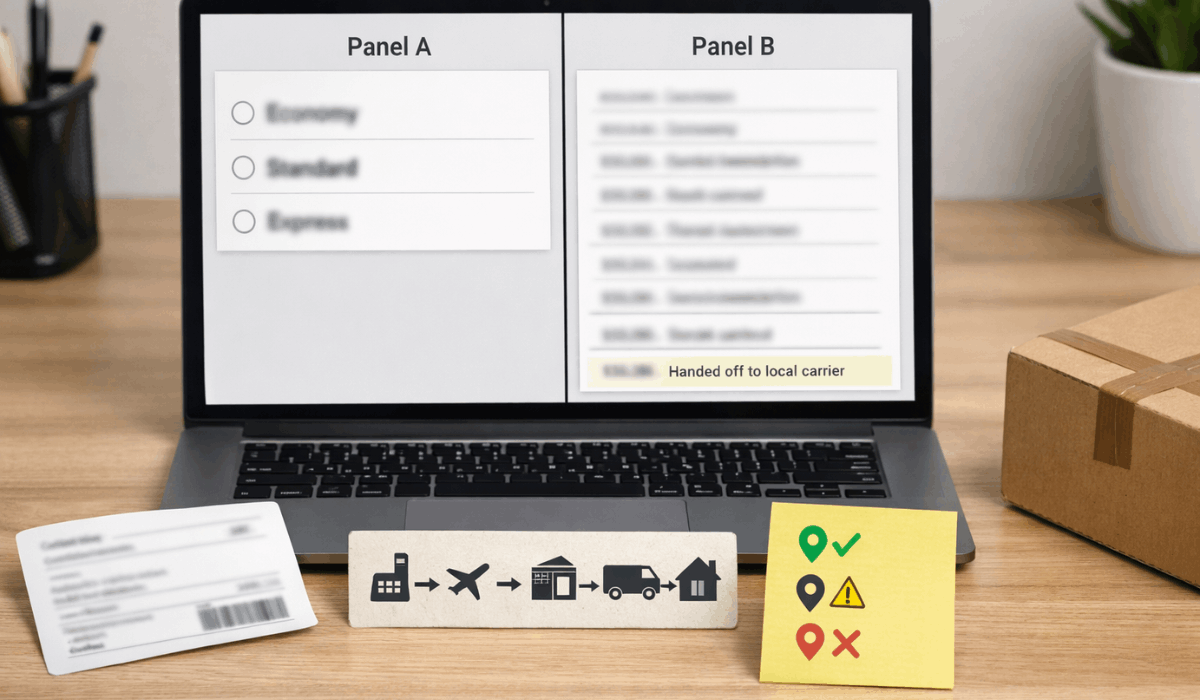
Shipping methods often look similar, but the tracking and handoff details change your risk.
Your goal is to confirm whether you can prove movement and delivery.
- Tracking type — Confirm tracked vs untracked and treat untracked as higher risk.
- Tracking coverage — Check if updates continue after the package crosses the border.
- Service level — Compare economy/standard/express by inclusions, not the label.
- Carrier handoff — Look for notes about transfer to local post or partner couriers.
- Delivery proof — Verify whether delivery is shown by scan, photo, or signature.
- Checkout record — Screenshot the option you selected for reference later.
Read Delivery Timeframes Without Getting Misled
Delivery windows are easy to misread because they combine multiple stages. You need to split the timeline and focus on what is measurable.
- Two-stage timeline — Separate processing time from transit time every time.
- Estimated language — Treat “estimated” as a range, not a commitment.
- Start point — Confirm whether the window starts at payment, dispatch, or first scan.
- Season caveats — Check peak periods, holidays, and weather disclaimers for delay risk.
- Remote areas — Look for regional exceptions that add days even with faster options.
- Your timeline — Track order date, dispatch date, and scan dates in your own notes.
Confirm Where the Package Ships From and Why It Matters
Shipping origin affects speed, taxes, and your ability to return the item. You should confirm the dispatch point before you rely on any timeline.
- Dispatch origin — Find the real ship-from location, not just a general region label.
- Ask if unclear — Message the seller to confirm the dispatch country before paying.
- Border complexity — Expect more gaps when the route crosses borders and uses handoffs.
- Return feasibility — Factor in the origin of the factor when assessing return costs, time, and practicality.
- Route clues — Watch for consolidation hubs or third-party logistics wording.
- Proof of origin — Screenshot the ship-from detail in case the listing changes later.
Customs, Duties, and Import Taxes: Who Pays and When
Import costs are often excluded from the item price and even from the shipping price. You should confirm whether fees are prepaid or collected on delivery.
- Who pays — Identify whether duties and taxes are included or paid on delivery.
- Clearance risk — Note the wording on customs clearance, as delays can occur there.
- Brokerage fees — Look for possible clearance or service fees charged by the carrier.
- Payment proof — Keep receipts ready in case customs requests value confirmation.
- Invoice access — Confirm the seller can provide an invoice if needed for clearance.
- Budget caution — If wording is vague, assume extra fees may apply at delivery.
Find Hidden Fees Before You Commit
Shipping cost is not always the final logistics cost. You should scan for add-ons that appear after the package has already started moving.
- Surcharges — Check for fuel or handling add-ons that change by route or carrier.
- Size rules — Review oversized or dimensional-weight notes for bulky items.
- Remote fees — Confirm whether certain regions trigger extra charges.
- Failed delivery — Look for re-delivery, storage, or address-correction fees.
- Currency costs — Watch for conversion fees if charges are processed in another currency.
- Total snapshot — Save the checkout breakdown to compare against later charges.
Delivery Exceptions, Liability Limits, and Red Flags
Policies often include exceptions that limit liability when things go wrong.
You should read these lines carefully because they shape your dispute options.
- Problem definitions — Find how the policy defines lost, delayed, and damaged.
- Liability cap — Note limits on compensation or declared-value restrictions.
- Handoff clauses — Flag “not responsible after handoff” language immediately.
- Vague policy — Treat copy-pasted or unclear wording as a reliability warning.
- Contradictions — Compare listing promises to fine print and note mismatches.
- Written confirmation — Ask questions in messages and keep the replies as proof.
Returns, Refusals, and Failed Delivery Rules
Returns are more complex across borders, and some policies make them impractical. You should confirm costs, time limits, and what happens if delivery fails.
- Return payer — Confirm who pays return shipping and how labels are handled.
- Fees and conditions — Check restocking fees and “unused” or “original packaging” rules.
- Return window — Verify the start and end times.
- Refusal outcome — Read what happens if you refuse delivery and what fees apply.
- Failed delivery — Check rules for missed attempts, pickup deadlines, and address errors.
- Return details — Save the return address and steps early so you do not rush later.

Claim Windows, Dispute Deadlines, and Proof You Should Save
Deadlines matter more than almost any other policy line. You should know exactly what proof is expected and when you must submit it.
- Non-receipt deadline — Identify the cutoff for “not received” claims and mark it.
- Damage deadline — Find the shorter window for damage reports and act quickly.
- Box condition photos — Photograph dents, tears, wet spots, or re-taped seams on arrival.
- Unboxing video — Record a simple unboxing for fragile or high-value orders.
- Tracking screenshots — Save tracking history, delivery status, and any delivery photo notes.
- Single evidence folder — Store messages, invoices, screenshots, and media in one place.
60-Second Shipping Policy Scan Before You Pay
You can run a quick scan to see whether the policy is safe enough for your risk level. Use this checklist to decide whether to proceed or step back.
- Go: Clear tracking — End-to-end updates with a defined proof-of-delivery method.
- Go: Clear timeline — Processing and transit are separated with a realistic window.
- Go: Clear import costs — Duties/taxes and who pays are explained in plain terms.
- Caution: Partial tracking — Updates stop early, or handoffs are unclear.
- Caution: Loose estimates — Broad “estimated” language with heavy delay exceptions.
- Caution: Costly returns — Returns are available, but the buyer pays under strict conditions.
- No-Go: Vague policy — Missing deadlines, missing proof rules, or unclear responsibility.
- No-Go: Weak liability — Strong limits plus “not responsible after handoff” wording.
- No-Go: Unclear fees — Multiple possible add-ons with no checkout breakdown.
Final Takeaway
Reading international shipping policies is mainly about three checks: total cost, a realistic timeline, and protection in case something goes wrong.
If you screenshot key lines, track your dates, and save proof as you go, you reduce surprises and improve your position in any claim.
Do a quick policy scan now, save your screenshots, and only pay when the rules match your risk level.