Clicking “buy” on an international order feels final. But the number on your confirmation email and the number a courier asks for at your door can be very different amounts.
Import taxes on online purchases catch repeat buyers off guard because the charges change based on factors buried deep in customs classification codes. That price gap between checkout and delivery sits at the center of this problem.
The surprise fees sting worse than the taxes themselves. Brokerage charges, storage penalties, and re-valuation holds can stack up faster than the duty percentage ever would.
This breakdown covers the math behind those surprise charges, the timing traps that create delays, and the specific documents that protect your ability to dispute.
What Import Taxes on Online Purchases Are Made Of
The phrase “import tax” sounds like a single line item. It hides at least four or five separate charges that hit at different moments during shipping and customs processing.
Customs duty is the percentage-based charge tied to the product type and its declared value. VAT, GST, or local sales tax gets applied on top of that, and some countries calculate it on the item price plus shipping and insurance combined. Those two charges are the government portion.
Then the carrier charges arrive. A customs clearance fee covers the paperwork processing. A brokerage fee pays the courier for submitting your documents to customs. And a disbursement fee kicks in when the courier pays customs on your behalf and collects from you later.
Storage and Late Payment Penalties
One charge that surprises people the most: storage fees. If payment or documents are delayed after your parcel arrives at a local facility, daily storage charges start building. The courier sends a notification, and a clock starts ticking immediately.
I think the storage fee problem is the single most overlooked cost in cross-border shopping because carriers like DHL and FedEx can start charging storage within 3 to 5 calendar days of the first payment notice.
Responding within 48 hours of any carrier notification should be a hard rule for every international buyer.
Why Two Identical Orders Get Taxed Differently
This is the part that frustrates people. Two friends buy the same product, the same day, shipped to the same country. One pays $12 in import fees. The other pays $38. The difference comes down to variables that have nothing to do with the product itself.
Declared Value Versus Price Paid
Customs authorities compare the declared value on the shipping label with your payment proof. If the seller writes a lower number on the customs declaration than what the transaction receipt shows, customs can reassess and apply duties on the higher amount.
Some sellers do this intentionally to reduce their buyer’s tax burden, but it backfires when customs catches it because the result is a re-valuation hold that delays everything.
Shipping Method Changes the Fee Structure
Courier shipping (DHL, FedEx, UPS) and postal shipping (national post services) produce completely different fee profiles.
Courier companies typically add brokerage and disbursement fees on top of the government taxes. Postal services usually skip those extra charges but process customs clearance more slowly. The trade-off looks like this:
| Factor | Courier (DHL, FedEx, UPS) | Postal Service |
|---|---|---|
| Brokerage fee | Usually charged ($5 to $15+) | Rarely charged |
| Speed through customs | Faster processing | Slower, depends on local post volume |
| Payment method | Online portal or payment link | Cash at pickup or post office payment |
| Total add-on fees | Higher due to service charges | Lower, but less tracking visibility |
Postal shipping tends to produce fewer surprise fees but longer wait times, while courier shipping costs more in service charges but clears faster.
Also read: How to Read International Shipping Policies
Product Category and Materials
A product classification code determines the duty rate. Cotton t-shirts get taxed differently than polyester blends. Electronics with lithium batteries face different treatment than electronics without them.
Even the quantity matters: ordering five of the same item can trigger a commercial import classification instead of a personal one, which changes the duty rate and sometimes the required documentation.
How Import Taxes Slow Down Delivery
Every import charge creates a clearance step, and every clearance step can pause your package. The delays fall into a predictable pattern that can be managed once the pattern becomes visible.
A customs assessment hold means the parcel sits while duties and taxes are calculated. This is normal and usually resolves within a day or two.
But a document request is where things get stuck. Clearance stops completely until the buyer provides an invoice, payment proof, or identification document. And the buyer often does not realize they need to act because the notification lands in a spam folder or an SMS they ignore.
After documents are submitted, the parcel still waits until fees are paid. Some carriers release packages for delivery and collect at the door. Others hold the package at a facility until online payment clears.
The worst-case delay happens during a re-valuation or random inspection. Customs questions the declared value or product description, and a manual review begins. These reviews have no fixed timeline, and the buyer has almost zero control over the speed.
Peak shopping periods (November through January, and mid-year sales events) add another layer. Customs processing backlogs during high-volume windows can push routine clearance times from 1 to 2 days out to a week or more.
The Pre-Checkout Math That Prevents Surprises
I would argue that running landed cost math before clicking “buy” eliminates about 80% of the frustration in cross-border shopping, based on how customs duties, VAT, and brokerage fees are the three charges that account for nearly all surprise costs.
The formula is straightforward: item price + shipping cost + estimated duties + estimated VAT/GST + likely brokerage or handling fees = total landed cost.
The tricky part is estimating duties and VAT. Duty rates vary by product category and destination country, so checking a duty calculator specific to your country is worth the two minutes it takes.
The World Customs Organization publishes the Harmonized System codes that determine duty rates globally, and most countries have a customs authority website where rates can be looked up by product type.
A few things to check before completing the order:
- Tax collection method: does the seller include taxes at checkout (DDP or tax-inclusive), or will charges arrive separately after shipping?
- Invoice availability: can the seller provide a proper commercial invoice? Some sellers on marketplace platforms cannot, which creates problems at customs
- Return terms for duties: if the item needs to go back, who pays return shipping, and does the destination country allow duty refunds on returned goods?
- Accurate product description: vague descriptions like “gift” or “sample” on customs forms trigger inspection flags
Tax-Inclusive Checkout Is Not Always the Better Deal
Every guide about import taxes recommends choosing tax-inclusive checkout (called DDP, or Delivered Duty Paid) whenever possible.
I disagree with this blanket advice because tax-inclusive prices often include a buffer of 10% to 20% above the real duty and VAT amount, which the seller keeps as margin on the customs estimate.
On a $200 purchase, that buffer can mean paying $15 to $25 more than the real tax amount. Paying on arrival (called DDU, or Delivered Duty Unpaid) means paying only the exact customs charge, even though it requires more effort to manage the payment process.
The catch with DDU is the brokerage fee that couriers add. So the math only works in the buyer’s favor when the seller’s tax-inclusive markup exceeds the courier’s brokerage charge.
That calculation changes with every order, which is exactly why running the numbers each time matters more than following a blanket rule.
Documents That Protect Disputes and Refund Claims
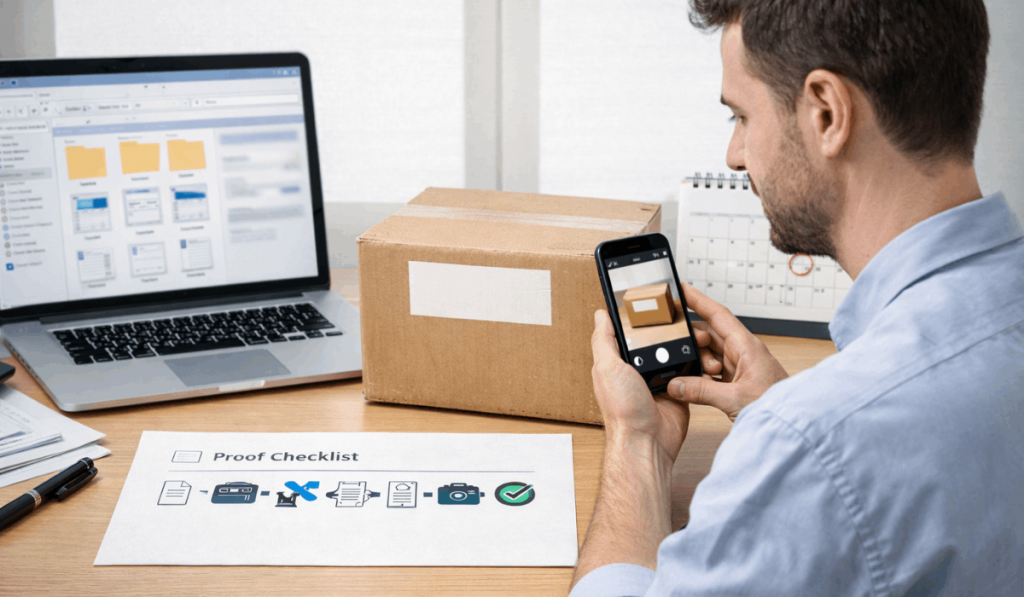
Saving proof at every stage is the only thing that gives a buyer leverage when charges are wrong or a return creates a refund gap. The documents that matter the most are specific to the customs and carrier process.
Keep these on file for every cross-border purchase:
- Order confirmation with item name, quantity, price, and shipping option
- Seller invoice or receipt that customs and carriers will request during clearance
- Payment proof showing the exact amount and currency charged
- Tracking history screenshots that show holds, timestamps, and clearance status updates
- Fee breakdowns from the carrier that itemize duties, taxes, brokerage, and storage charges separately
A common mistake is assuming the item refund covers everything. When returning an international purchase, the seller refunds the item price, but brokerage fees, clearance charges, and disbursement fees usually stay with the buyer.
Tax refunds on returned goods depend on local rules, and some countries require export proof (showing the item left the country) before processing a duty refund.
The World Trade Organization has country-specific trade policy information that can clarify refund eligibility by destination.
Refusing delivery to avoid paying import fees almost always backfires. The carrier still charges processing fees, and the refund timeline on the original item stretches significantly when the package goes through a return-to-sender loop across borders.
Questions People Ask About Import Taxes on Online Purchases
Q: Do all online purchases from other countries get charged import tax?
Not every order gets taxed. Many countries set a de minimis threshold, which is a minimum value below which imports are tax-free. That threshold varies wildly: some countries set it at $20, others at $200 or more. Check your country’s customs authority for the current limit.
Q: Can I get a refund on import taxes if I return the item?
Sometimes, but the process is strict. The refund depends on local customs rules, and most countries require proof that the item physically left the country. Brokerage and handling fees charged by the carrier are almost never refundable, even if the item refund goes through.
Q: Why did the courier charge me a fee on top of the customs duty?
That extra charge is usually a brokerage or disbursement fee. The courier pays customs on your behalf and then bills you for the service. Postal services rarely charge this fee, but private couriers like DHL, FedEx, and UPS include it as standard practice on most international shipments.
Q: How do I avoid getting scammed by fake customs payment requests?
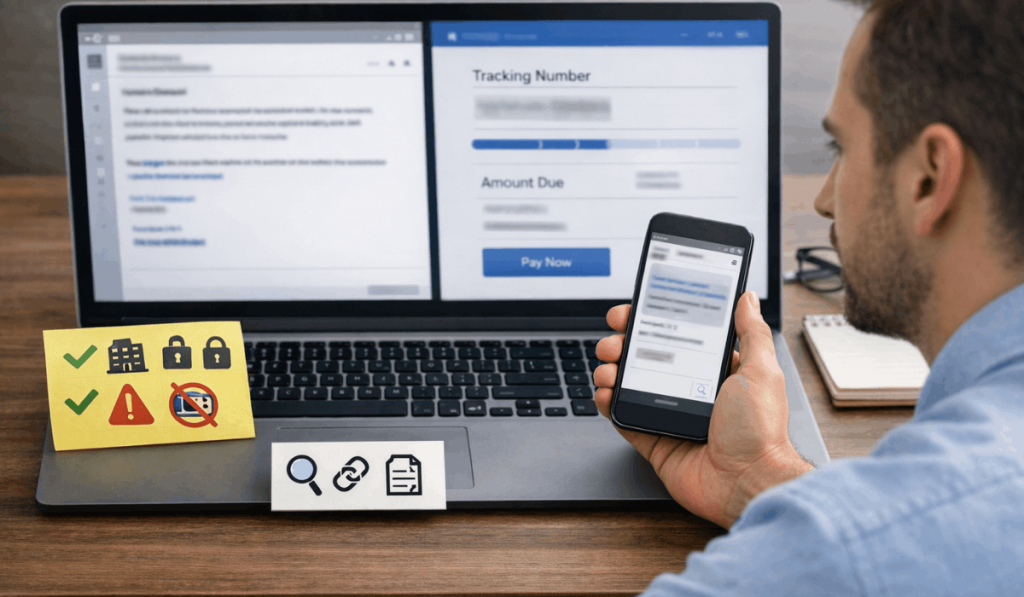
Legitimate carrier payment notices always reference your tracking number and shipment details. Cross-check the sender’s email domain against the carrier’s official website. Never click payment links in messages that do not include your specific tracking number.
Q: Does marking a package as a gift remove import taxes?
No. Marking items as “gift” does not bypass customs duties in most countries. Customs authorities look at the declared value regardless of the label. Using “gift” labels to reduce taxes is technically customs fraud, and if caught, the result is delays, fines, and a flagged shipping address for future orders.
Conclusion
Import taxes on online purchases become manageable once the math happens before checkout rather than after delivery. The real protection comes from saving every invoice, receipt, and tracking screenshot starting on the day the order is placed.
Carriers and customs offices respond to documented disputes far more seriously than verbal complaints alone. Running one quick landed cost calculation per order can save more money than any coupon code ever will.