Clicking “confirm” on an international order feels like a two-second decision. But that two seconds locks you into shipping timelines, customs fees, and return policies that cross borders.
A wrong variant or unclear listing can cost weeks in disputes. And international return shipping alone can eat half the item’s price.
This international order checklist breaks down what to verify before your money leaves the country. Each check targets a specific failure point that repeat cross-border buyers run into.
The goal here is simple: fewer surprises after payment, and stronger proof if something goes wrong.
How to Verify Product Details on an International Listing
Getting the right item sounds obvious. But international listings create confusion that domestic ones rarely do, because the same product can ship in region-specific versions with different specs, plugs, and bundle contents.
A phone listed as “Global Version” might still arrive with firmware locked to a specific region. A kitchen appliance might match the photos but ship with a plug type that doesn’t fit your outlets without an adapter. These details hide in plain sight.
Check Your Exact Variant Before Confirming
Lock down every variable: color, size, model number, region version, plug type, and what’s bundled in the box. Cross-check the product title against the spec table and the listing photos. If any of those three disagree with each other, that’s a red flag worth pausing for.
I would skip any listing on AliExpress or similar platforms where the “in the box” contents aren’t clearly photographed or listed, because vague bundle descriptions are the number one cause of “missing parts” disputes in cross-border orders.
Look for Proof Photos of Weak Points
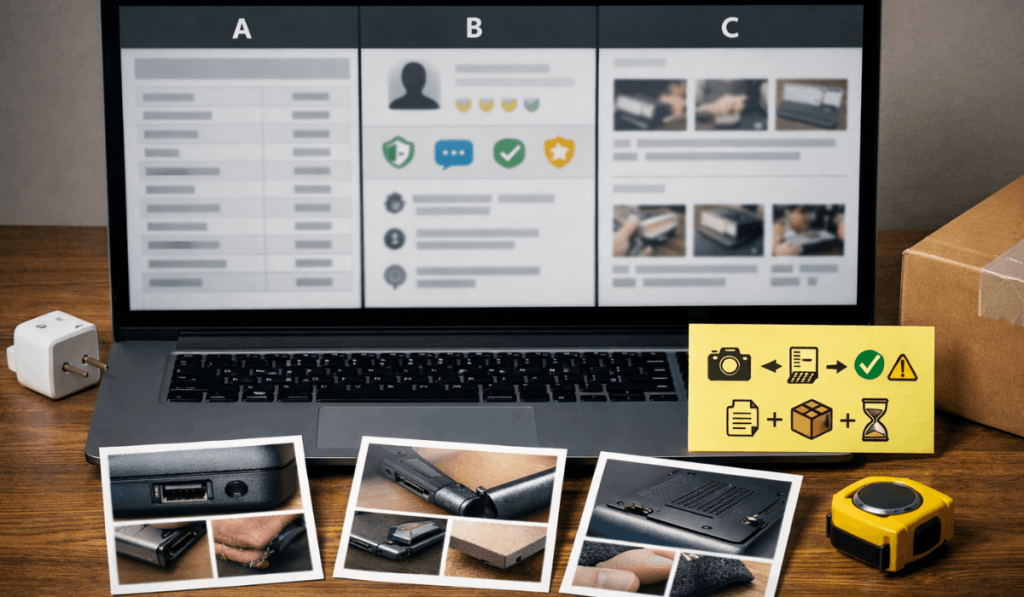
Spec sheets tell you what a product should be. Photos of ports, seams, hinges, edges, and the underside tell you what it is. Listings that only show marketing-angle glamour shots are hiding something, or at minimum, not trying to earn your trust.
Does the Seller’s Track Record Hold Up Under Pressure?
Seller ratings on international platforms can be misleading. A store with a 98% positive rating and 10,000 orders looks solid on paper. But that number averages years of data, and a seller’s current performance can look completely different from their six-month-old performance.
Recent Feedback vs. Lifetime Score
Sort reviews by date. A seller who had great reviews in 2024 but picked up repeated complaints about wrong items or weak packaging in late 2025 and into 2026 is a different seller now. The lifetime score hasn’t caught up yet.
Focus on negative feedback patterns. One complaint about a late delivery means nothing. Five complaints about the same issue in the last 90 days is a prediction, not a coincidence.
Test the Seller Before Buying
Send one direct question about your specific variant, shipping method, or packaging approach before you order.
A seller who responds with a specific, clear answer within 24 hours is telling you something about how they’ll handle a problem later. A seller who sends a copy-paste reply or ignores the question is telling you something too.
Also translate their return policy into plain language: who pays return shipping, what condition does the item need to be in, and how long do you have to file? These three details decide whether a return is practical or just theoretical.
Reading International Reviews Without Getting Fooled
Review sections on cross-border platforms are a different animal from Amazon US or UK reviews. The fake review problem is worse, the language barriers create noise, and the review volume can make patterns hard to spot.
Prioritize Photo and Video Reviews of Your Exact Variant
I think the common advice to “read as many reviews as possible” before buying internationally is a waste of time.
On platforms like AliExpress, Temu, and some Shopee stores, I’d estimate 3 out of 5 text-only reviews carry no useful signal because they’re either incentivized, auto-translated poorly, or left by buyers who purchased a different variant.
Photo and video reviews of the exact model, size, and color you selected are the only reviews worth spending time on.
Look for photos that show the item in real lighting, not studio lighting. Check close-ups of edges, connectors, and moving parts. And if the reviews look too uniform in length, tone, and timing, treat that pattern with suspicion.
Spot Repeated Problems Quickly
Scan for clusters of the same complaint: dead on arrival, missing accessories, or damaged packaging. Two or three people mentioning the same problem across recent months is a reliable indicator. One person complaining about something vague is noise.
Also read: What Materials Say About Product Durability
Calculating the True Cost of an International Order
The listed price on an international order is almost never the final price. Taxes, duties, shipping tiers, and platform service fees stack up, and they’re easy to miss at checkout if you’re not actively calculating.
Here’s what a true cost breakdown looks like for a typical international purchase:
| Cost Component | Where to Find It | Common Trap |
|---|---|---|
| Item price | Listing page | Shown in seller’s currency, not yours |
| Shipping fee | Checkout page | Low item price offset by high shipping |
| Import duties/taxes | Customs calculator for your country | Depends on item category and declared value |
| Platform service fee | Checkout summary or terms page | Sometimes hidden until final confirmation |
| Currency conversion fee | Payment provider terms | Banks and PayPal add 2-4% on top of exchange rate |
The trap that catches most buyers: a low item price paired with inflated shipping costs that make returns financially pointless.
Save a screenshot of your checkout summary including the currency shown. That screenshot becomes critical evidence if the final charge doesn’t match what was displayed.
International Delivery Times: Building a Realistic Timeline
Processing time, transit time, customs clearance, and local delivery handoff are four separate stages. Each one can stall independently. An estimated delivery window of “15-30 days” hides a lot of variability depending on the route, the season, and the carrier.
Why Processing Time Gets Ignored
The clock on delivery doesn’t start when you pay. It starts when the seller actually ships the item. Processing time can range from 1 to 7 days on most platforms, and during peak seasons like November sales or Chinese New Year, that window stretches further.
Customs Delays Are Category-Specific
Electronics, batteries, liquids, and cosmetics face longer clearance times than clothing or accessories. If your item falls into a restricted category, add extra days to your timeline. And during holiday periods, customs offices in many countries operate on reduced schedules.
Save screenshots of the estimated delivery window shown at checkout. If you need to file a late-delivery dispute, that screenshot is your starting evidence.
Preparing for Returns and Disputes Before They Happen
The mistake most cross-border buyers make is thinking about returns after something goes wrong. The time to prepare is before you click confirm, because dispute deadlines and evidence requirements are strict on international platforms.
Three deadlines matter on every international order:
- Confirmation window: the number of days before the platform auto-confirms receipt and releases payment to the seller
- Return request window: how many days after delivery you can open a return case
- Dispute escalation cutoff: the final date you can escalate to the platform if the seller doesn’t resolve your issue
Missing any one of these deadlines can mean losing your ability to get a refund, even if the item is clearly defective.
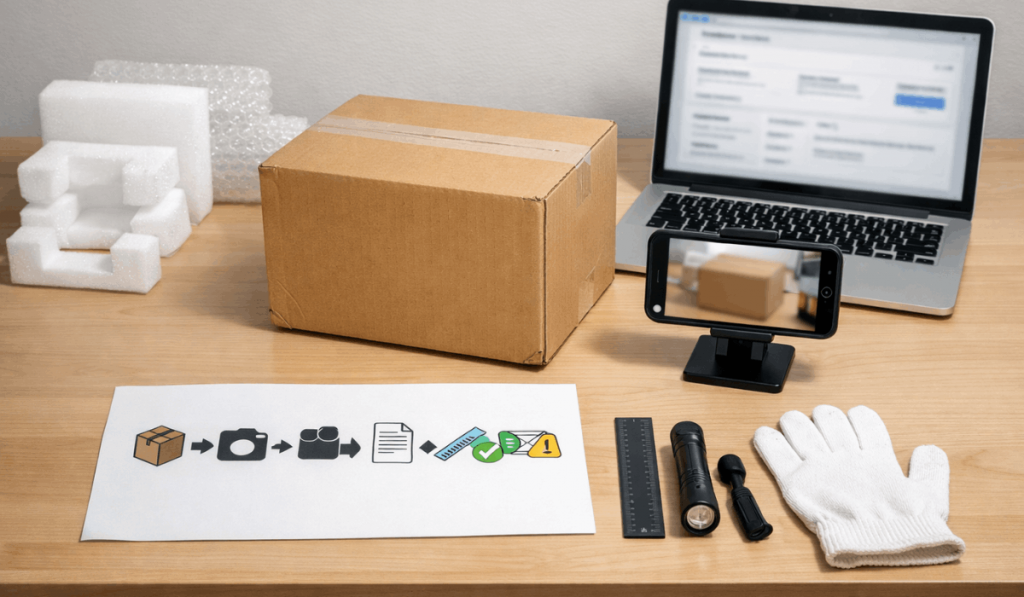
Build a Proof Routine for Every Delivery
The evidence you collect at delivery determines whether your dispute succeeds or fails. Keep this routine consistent for every international package:
- Photograph the sealed box on all sides, including tape lines, corners, and any visible damage
- Record a continuous, uncut unboxing video from sealed box to fully revealed contents
- Measure and photograph any defects immediately, using a ruler or coin for scale reference
- Take side-by-side comparison photos if the item doesn’t match the listing
This takes about 3 minutes per package. But those 3 minutes are the difference between a refund and a denied claim.
Compliance Checks That Can Get Your Package Seized
Some items get delayed, returned, or seized at customs because of import restrictions the buyer never checked. Batteries, liquids, cosmetics, and certain branded goods commonly trigger problems at borders.
Electronics deserve extra attention. A charger or power adapter might not carry the safety certification required in your country. A phone might have a SIM lock or region-locked firmware that makes it partly or fully unusable at your location.
Check three things before buying electronics internationally:
- Voltage and frequency compatibility: does the device work with your local power standard, or do you need a converter?
- Certification requirements: does your country require specific safety marks on chargers and power devices?
- Region locks: is the firmware, SIM slot, or software restricted to the seller’s country or region?
The cost of getting this wrong isn’t just the item price. Return shipping on electronics internationally can cost as much as the original order, and some carriers won’t ship lithium battery items back at all.
After-Sales Support and Warranty on International Purchases
A warranty that only covers the seller’s home country is barely a warranty at all. And on cross-border platforms, warranty scope varies widely between sellers, brands, and product categories.
Ask the seller directly: does the warranty cover your country? What proof do they need to process a claim? And if a replacement is required, who pays for shipping?
The difference between a seller who answers “we’ll handle it” and one who says “send photos of the defect, the order number, and the item label, and we ship a replacement within 5 business days” tells you everything about whether that warranty has teeth.
60-Second Go or No-Go Checklist for International Orders
Run this quick filter before every international purchase. Each line represents a common failure point that creates problems after payment:
- GO: Listing photos, title, and spec table all match your selected variant
- GO: Recent photo reviews show your variant with no repeated complaints
- CAUTION: Total cost is acceptable but tracking looks limited or delivery estimates seem optimistic
- CAUTION: Seller ratings are strong but recent feedback shows delays or packaging complaints
- NO-GO: Listing has spec conflicts, or the seller dodges direct questions about what you’ll receive
- NO-GO: Return shipping is impractical, dispute deadlines are unclear, or payment is pushed off-platform
If any NO-GO condition is present, walk away from that listing. A good price on a bad listing is still a bad deal.
Questions People Ask About International Order Checklists
Q: How long should I wait before confirming receipt on an international order?
Use every day the platform gives you. Auto-confirmation releases payment to the seller, and once that happens, your dispute options shrink dramatically. On most platforms, the confirmation window is 15 to 20 days after marked delivery.
Q: Can I get a refund if customs seizes my international package?
It depends on the platform and the reason for seizure. If the seller shipped a restricted item without proper documentation, most platforms side with the buyer. But if you ordered something banned in your country, that’s on you. Check import rules before ordering.
Q: Are international seller warranties worth anything?
Only if the seller spells out the process in writing before purchase. Vague promises like “we support our customers” mean nothing when you’re trying to ship a defective product back across the ocean. Ask for specifics on proof requirements and who covers return shipping.
Q: Should I always buy shipping insurance on international orders?
For items over $50, I would add shipping insurance on platforms like AliExpress or DHgate, because the cost is usually under $3 and the claim process for lost packages without insurance can drag on for months. Under $50, the insurance math rarely works out.
Q: Is it safer to pay with PayPal for international orders?
PayPal’s buyer protection program adds a dispute layer on top of the platform’s own system. That extra layer has saved a lot of cross-border buyers. But PayPal’s currency conversion fees run higher than most credit cards, so factor that into your total cost. The OECD’s cross-border e-commerce guidelines also offer useful background on consumer protections across countries.
Conclusion
Treating every international order like a small project keeps surprises to a minimum after payment. The checklist habit takes minutes but saves weeks of disputes and return shipping headaches.
Smart cross-border buying comes down to proof collection, deadline awareness, and honest listing evaluation. That next international purchase should feel boring at checkout, because boring means you did the work.