That international order sitting in your cart looks like a good deal. But the shipping policy buried three clicks deep might tell a different story about what happens after you pay.
Reading international shipping policies feels boring until a package vanishes between countries. Then it becomes the one document that determines whether you get a refund or a shrug emoji from customer service.
The problem is that shipping policies are written to protect sellers, not buyers. Every vague word and missing deadline works against the person placing the order.
This guide breaks down what to scan, what to screenshot, and where international shipping policies hide the details that cost real money in 2026.
How International Shipping Policies Are Structured
A shipping policy is a mix of seller promises and logistics rules that kick in after payment goes through. The tricky part is figuring out which lines the seller controls and which ones fall on the carrier.
Some policies are written by the seller. Others come directly from the fulfillment center or a third-party logistics provider. That distinction matters because a seller can promise 5-day delivery while the carrier’s terms say 5 to 15 business days.
Seller Commitments vs. Carrier Delays
The seller controls processing time: how long it takes to pack and hand off the order. The carrier controls transit time: how long the package moves through the shipping network. A policy that blends these two numbers into a single “delivery estimate” is already hiding information.
Look for language that separates processing from transit. If the policy only says “delivery in 7-14 days” without specifying when the clock starts, that number is almost meaningless.
Does the timer begin at payment, at dispatch, or at the first tracking scan? Each answer changes the real timeline by days.
Where the Policy Lives on the Site
Shipping policies can sit on the product listing, the checkout page, the help center, or the order confirmation email. And sometimes the wording differs between locations.
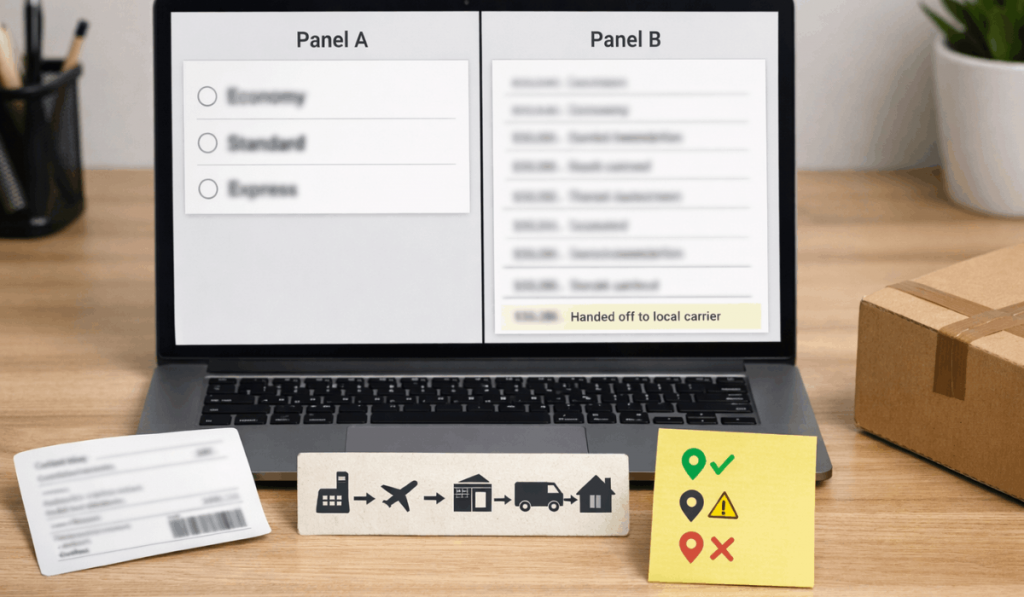
I would screenshot the checkout page and the help center version side by side before placing any order over $50, because I’ve seen contradictions between listing promises and fine print buried in FAQ sections. That checkout screenshot becomes your strongest evidence if a dispute arises later.
Shipping Methods and Tracking Levels That Change Everything
Picking a shipping method sounds simple. Economy, standard, express. But the label tells you almost nothing about the tracking coverage or carrier handoff process that determines whether you can prove delivery.

Tracked vs. Untracked Shipping Risk
Untracked shipping is a gamble on international orders. If the package disappears, you have no scan history to back up a claim. Some platforms won’t even process a refund request without tracking data.
But I think the common advice to “always pick tracked shipping” misses a real problem: tracked shipping that loses coverage at the border crossing can be worse than no tracking at all.
A package that shows “handed to local carrier” as its last scan and then goes silent for 3 weeks gives you a false sense of security while the dispute window quietly closes.
Partial tracking makes people wait longer before filing claims, and that delay can push them past the platform’s refund deadline.
When Tracking Stops at the Border
Check whether the tracking updates continue after the package crosses into your country. Many economy shipping options provide full tracking in the origin country but switch to a local postal service with little or no scan coverage after the handoff.
The policy should mention carrier handoffs explicitly. Look for phrases like “transferred to local post” or “partner courier.” If the policy doesn’t mention handoffs at all, assume tracking will disappear mid-route. Save the last known tracking screenshot before that gap appears.
Delivery Timeframes Designed to Confuse
Delivery windows on international orders are built from multiple stages, and sellers often combine them into a single range that sounds faster than reality. Splitting the timeline into pieces is the only way to set realistic expectations.
Processing Time vs. Transit Time
Processing time covers packing, labeling, and handing the order to the carrier. Transit time covers the carrier’s journey. A seller who advertises “delivery in 10-20 business days” might mean 5 days of processing plus 5-15 days of transit. Or it might mean the opposite.
Always confirm what “business days” means. Some sellers exclude weekends and holidays. Others use calendar days. And cutoff times matter too: an order placed at 6 PM on Friday might not enter the processing queue until Monday morning, adding 2-3 days that don’t appear in the estimate.
Peak Season and Remote Area Delays
Policies often include disclaimers about holiday periods, weather disruptions, and remote delivery zones. These aren’t throwaway lines.
A remote area surcharge or extended delivery window buried in a policy footnote can add a full week to delivery and $10 to $20 in extra fees, depending on the carrier.
Check whether your postal code falls into the carrier’s “remote area” list before assuming the standard timeline applies to your address.
Also read: What to Check Before Confirming an International Order
Customs, Duties, and Fees That Show Up After Checkout
Import costs are the part of international shipping policies that catch first-time cross-border shoppers off guard. The item price and the shipping price often exclude customs duties, import taxes, and brokerage fees that get collected at delivery or charged to a credit card days later.
Who Pays Import Taxes: DDP vs. DDU
Two terms control who handles customs costs. DDP (Delivered Duty Paid) means the seller covers duties and taxes upfront. DDU (Delivered Duty Unpaid) means the buyer pays at delivery or pickup. If the policy doesn’t specify, assume DDU.
A common mistake is treating DDP and DDU as interchangeable. A $40 item shipped DDU to a country with a 20% VAT rate means an $8 surprise charge at the door, plus any brokerage fee the carrier adds for processing customs paperwork.
The seller should be able to provide a commercial invoice if customs requests one. Confirm this before ordering, especially for items over $100. The Universal Postal Union maintains customs guidelines that explain how duties apply across member countries.
Hidden Surcharges and Currency Conversion Fees
The shipping fee at checkout might not be the final logistics cost. Fuel surcharges, dimensional weight calculations for bulky items, and re-delivery fees after a missed attempt can all appear after the package is already moving.
Currency conversion is another quiet cost. If the seller processes charges in a different currency, your bank or payment processor may add a 1% to 3% conversion fee on top. Save the full checkout breakdown as a screenshot so you can compare it against the final charges on your statement.
These are the fees worth scanning for before committing:
- Fuel and handling surcharges that change by route or carrier
- Dimensional weight pricing on oversized or bulky items that gets calculated by box size instead of actual weight
- Re-delivery or address correction fees charged after a failed first attempt
- Currency conversion markups applied by your payment provider, not the seller
Returns, Refusals, and Disputes Across Borders
International returns are where shipping policies get ugly. Domestic return rules rarely apply, and the cost of shipping an item back to another country can exceed the product’s price. Reading the return terms before ordering saves a lot of frustration later.
| Feature | Domestic Order | International Order |
|---|---|---|
| Return shipping cost | Often free or prepaid label | Buyer pays, often $15-$40+ |
| Return window | 14-30 days typical | Varies, sometimes shorter |
| Refund timeline | 3-7 business days | 2-6 weeks after item received |
| Restocking fee | Rare | Common, 10-25% of item price |
International orders carry higher return costs and longer refund timelines across every category.
Return Shipping Costs and Restocking Fees
Return shipping on international orders almost always falls on the buyer. Some sellers offer partial refunds instead of returns because the logistics cost exceeds the item value.
Check whether the policy mentions restocking fees, “unused condition” requirements, or “original packaging” rules that make returns impractical.
The return window start date matters too. Does it begin at delivery, at dispatch, or at purchase? A 14-day return window that starts at purchase can expire before the package even arrives on a slow international shipment.
Claim Deadlines and the Proof Folder
Claim deadlines are the single most overlooked line in any international shipping policy. A “not received” claim might have a 30-day window. A damage claim might have a 7-day window. Missing these deadlines means losing your right to a dispute, no matter how strong your evidence is.
The moment any international package arrives, do these things:
- Photograph the exterior of the box before opening, capturing any dents, wet spots, re-taped seams, or tears
- Record a simple unboxing video for fragile or high-value items
- Screenshot the final tracking status including delivery confirmation and any delivery photo
- Save all messages, invoices, and policy screenshots in a single folder organized by order number
PayPal’s Resolution Center accepts tracking screenshots and message records as dispute evidence, and having everything in one folder cuts the claim filing process down to minutes. Mark the claim deadline on your calendar the day the order ships.
60-Second Shipping Policy Scan Before Paying
A quick scan at checkout can separate a safe order from a risky one. Run through these signals before entering payment details.
Green lights: end-to-end tracking with proof of delivery, processing and transit times listed separately, duties and taxes explained with a clear payer identified.
Yellow flags: tracking that stops at the border handoff, broad “estimated” delivery language loaded with delay exceptions, returns available but buyer-paid under tight conditions.
Red flags: no claim deadlines listed, “not responsible after handoff” wording, missing checkout fee breakdown with vague mentions of possible surcharges. A policy that hits two or more red flags deserves a pass, regardless of how good the price looks.
Questions People Ask About International Shipping Policies
Q: Can I get a refund if the international shipping policy was misleading?
A dispute filed through your payment provider or marketplace platform can succeed if you have a screenshot of the original policy showing different terms than what happened. The screenshot timestamp matters, so capture it before placing the order.
Q: Do international shipping policies apply to free shipping orders?
Absolutely. “Free shipping” only means the base shipping fee is waived. Customs duties, import taxes, and brokerage fees still apply unless the policy states DDP terms. Read the customs section even when shipping shows $0.
Q: How long should I wait before filing a lost package claim on an international order?
Check the policy’s stated delivery window first, then add the buffer period it specifies. Filing too early gets rejected, but waiting too long can push past the claim deadline. Mark both dates on a calendar the day tracking goes live.
Q: Should I always choose the fastest international shipping method?
Speed costs more but doesn’t always mean better protection. Economy tracked shipping with full border-to-door scan coverage can be safer than express options that hand off to an untracked local courier at the final mile.
Q: Are shipping policies different on marketplace platforms vs. independent stores?
Marketplace platforms like Amazon or eBay layer their own buyer protection policies on top of the seller’s terms. An independent store’s shipping policy is the only policy, so it deserves closer reading and more screenshots before payment.
Conclusion
Every international shipping policy answers three questions: what the total cost is, when delivery happens, and what protection exists if something breaks. Screenshot the answers to those three questions before placing the order.
Save tracking updates, message records, and delivery photos in one folder as the order moves. The next international order in your cart deserves a 60-second policy scan before the buy button gets any attention.