Ordering a pair of sneakers from overseas feels exciting until the tracking page reads “held at customs” for two weeks. That pit-in-your-stomach moment is more common than anyone admits.
Customs problems when shopping online usually come down to three or four small details that the buyer never checked. And the worst part? The fix takes five minutes before you click “buy.”
Every international package passes through a government checkpoint. The customs office decides if your order clears, gets taxed, sits in limbo, or gets sent back entirely.
This article breaks down exactly where online shoppers mess up at customs and how to stop those problems before they start.
What Customs Officers Are Checking on Every Package
The customs process is not random. Officers follow a specific checklist, and your package gets scored against it. Knowing what they look at puts you ahead of 90% of online shoppers who just hope for the best.
Every international shipment gets reviewed for the same core elements: declared item description, declared value, country of origin, and whether the item falls into a restricted category. Duties and taxes get calculated from those details.
The shipping method and carrier also matter because postal services and couriers follow different clearance rules.
Declared Value and Why It Triggers Holds
The declared value on your customs form is the single biggest factor in whether your package clears quickly or gets flagged.
Customs compares the stated price against payment records, marketplace listings, and category averages. A $300 handbag declared at $15 raises an immediate red flag.
I would avoid any seller who offers to “write a lower value on the customs form” because that tactic triggers seizure penalties in countries like Brazil, India, and most of the EU. The savings on duties are never worth the risk of losing the entire package.
What catches people off guard: the declared value also affects insurance claims. If a seller marks your $400 drone as $25 and it arrives damaged, your claim is capped at $25. That detail gets buried in every other guide on this topic.
Product Description Accuracy
Vague descriptions like “gift” or “household item” are customs magnets for inspection. Officers need specific product names, materials, and intended use. A listing that says “metal tool” instead of “stainless steel kitchen knife set” will sit in a review queue.
Sellers who write accurate, specific product descriptions on customs forms tend to get their packages cleared faster. Check the listing for clear item names before ordering, and look at buyer reviews that mention customs delays as a warning signal.
Products That Get Flagged at Customs More Often
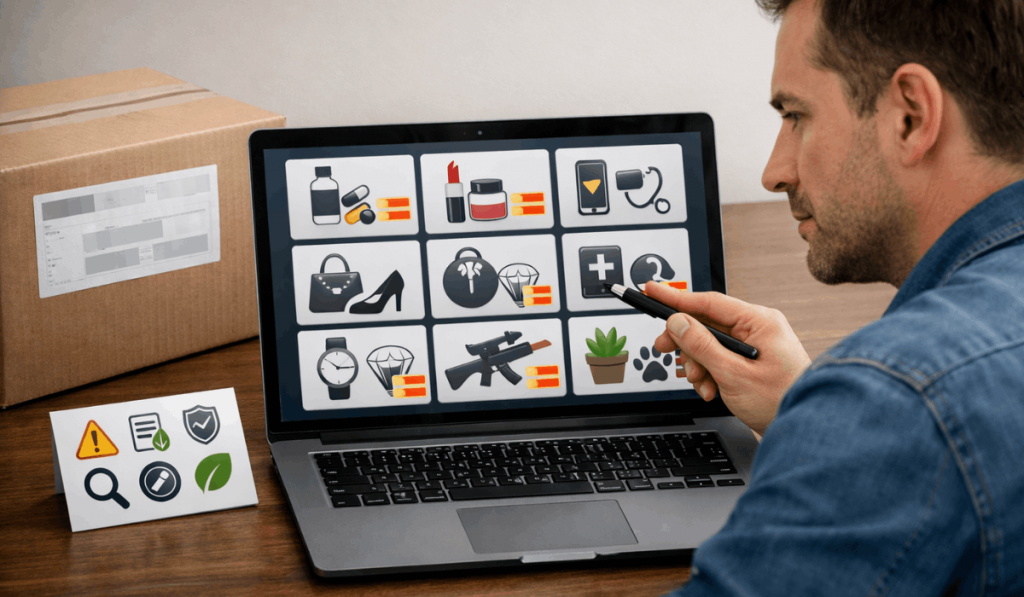
Not everything gets equal treatment at the border. Certain product categories face stricter inspection because they touch on health, safety, or intellectual property rules. Knowing which categories carry higher risk can save you weeks of waiting.
The items below get pulled for inspection at much higher rates than regular consumer goods:
- Food, supplements, and medications: health agencies in the destination country often need to approve these separately, and many are outright banned from import
- Electronics containing lithium batteries: safety regulations require specific packaging and labeling, and many postal carriers refuse lithium shipments entirely
- Branded fashion and luxury goods: anti-counterfeit inspections are standard, especially on items shipping from manufacturing hubs in East and Southeast Asia
- Cosmetics and skincare: ingredient restrictions vary wildly between countries, and a product legal in South Korea might be banned in the EU
- Plants, seeds, and animal products: biosecurity rules are the strictest category, and these get confiscated without warning in countries like Australia and New Zealand
A good rule: if the product touches your body, goes in your body, or could be a knockoff, expect customs to look at it more closely.
Express Courier vs. Postal Mail for Customs Clearance
This is where I disagree with the standard advice. Everyone says to use express couriers like DHL, FedEx, or UPS because they clear customs faster. That is true on average. But the full picture is more complicated.
Express couriers file a formal customs declaration on every single package. That means 100% of your shipments get reviewed.
Couriers have dedicated clearance teams, and they process things quickly, but they also charge brokerage fees that can run $10 to $25 per package on top of duties. Those fees rarely show up at checkout.
Postal services like USPS, Royal Mail, or Japan Post process packages in bulk. Low-value items under the duty-free threshold (called the de minimis value) often pass through with minimal individual review. The tradeoff is slower delivery and weaker tracking.
| Feature | Express Courier (DHL, FedEx, UPS) | Postal Service (USPS, Royal Mail, etc.) |
|---|---|---|
| Customs filing | Formal entry on every package | Bulk processing, simplified for low-value |
| Brokerage fees | $10-$25 per package (common) | Rarely charged |
| Tracking quality | Full end-to-end | Often gaps during customs |
| Speed through customs | 1-3 days typical | 3-14 days typical |
| Duty collection | Charged before delivery or on arrival | Charged on pickup or delivery |
The takeaway: for high-value orders above your country’s duty-free threshold, express couriers are worth it because you want clear documentation and fast resolution if something goes wrong.
For low-value purchases under that threshold, postal mail may actually clear with less friction and zero brokerage fees.
Also read: What Happens If a Seller Stops Responding
Seller Reliability and How It Affects Customs Outcomes
The seller’s experience with international shipping directly affects whether your package clears customs or gets stuck. An inexperienced seller who fills out customs forms incorrectly creates problems that land on the buyer, not the seller.
This is a detail that almost no customs guide mentions: the buyer is the importer of record.
Legally, the person receiving the package is responsible for the customs declaration, even though the seller filled out the form. If a seller under-declares, mislabels, or ships a restricted item, the fines and seizures fall on the buyer’s side of the border.
How to Check a Seller’s Customs Track Record
Look for specific signals before placing an international order:
- Buyer reviews that mention “customs delay,” “extra charges on delivery,” or “seized at border” are red flags
- Sellers who list clear country of origin and specific product descriptions on their listings tend to file customs forms correctly too
- A seller offering Delivery Duty Paid (DDP) shipping has priced customs fees into the cost upfront, which removes surprise charges at delivery
- Sellers on established platforms like Amazon Global or AliExpress typically have standardized customs form templates, reducing human error
Documents the Buyer Should Keep Ready
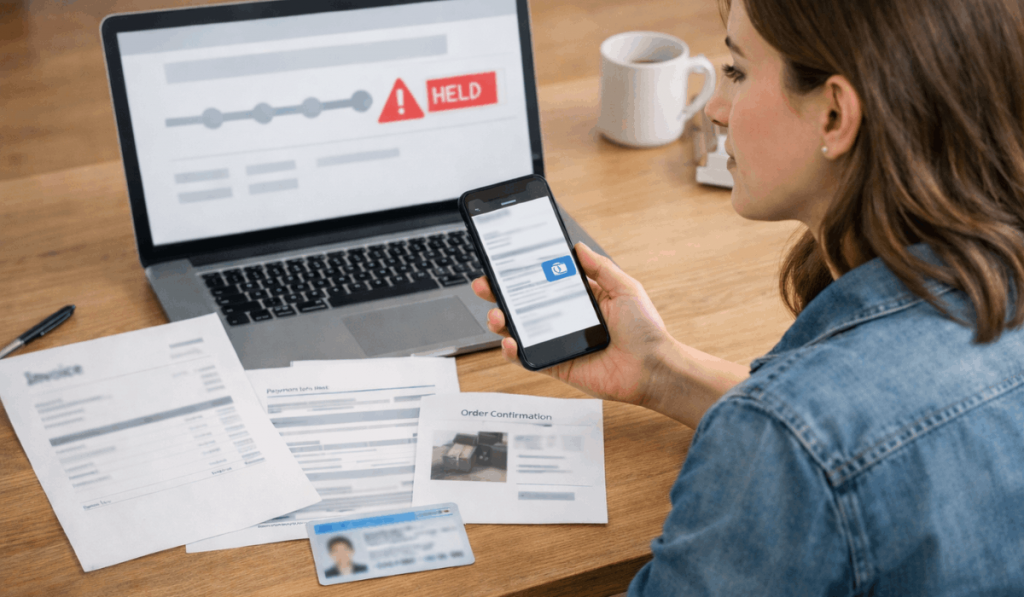
Customs may request documents to verify a purchase. These requests are time-sensitive, often giving 5-7 business days before the package gets returned. Having these ready cuts response time:
- Proof of payment: bank statement, PayPal receipt, or card confirmation
- Commercial invoice: listing the item description, quantity, and price
- Order confirmation: screenshot or PDF from the marketplace
- Personal identification: passport or national ID, required in countries like Brazil, Turkey, and India
Missing even one document can add a week to the hold. I would recommend saving order confirmations as PDFs the moment a purchase goes through, because chasing down a 30-day-old order page on a marketplace is not fun.
Country-Specific Customs Rules That Catch Shoppers Off Guard
A product that clears customs in the United States without a second glance might get rejected in Germany or held for weeks in Nigeria.
Duty-free thresholds are the biggest variable. The EU dropped its duty-free threshold to €0 for commercial imports in 2021, meaning every single package gets assessed for VAT. The US still has a $800 de minimis threshold in 2026, which is among the highest in the world.
Check your country’s customs authority website before ordering internationally. The World Customs Organization maintains links to every national customs authority, and a five-minute check can prevent a three-week hold.
Other country-specific traps to watch for:
- Australia and New Zealand confiscate all undeclared food, plant, and animal products without exception
- India requires a KYC (Know Your Customer) verification for packages above certain value limits
- Brazil charges a flat 60% import tax on purchases above the duty-free limit, and the process can take 30-60 days through postal mail
- EU countries collect VAT on all commercial imports regardless of value, and IOSS (Import One-Stop Shop) registration by the seller determines whether VAT is paid at checkout or on delivery
What to Do When a Package Gets Held at Customs
A customs hold does not mean the package is lost. The hold usually means customs needs more information or payment. Acting fast matters because most customs offices set a deadline, typically 5-30 days depending on the country, before they return or destroy the package.
Check tracking first. Carrier tracking pages usually include notes about what customs needs: documents, payment, or inspection clearance. Contact the carrier, not the customs office directly, because couriers handle most customs communication on behalf of the buyer.
Pay any duties or taxes immediately. Delays in payment extend holds, and some carriers charge daily storage fees after a grace period. Do not assume the issue will resolve on its own. Follow up every 2-3 days until the package is released.
Questions People Ask About Customs Problems Online Shopping
Q: Can I avoid customs fees on international orders?
Customs fees depend on the item value, product category, and your country’s duty-free threshold. Orders below the de minimis value may pass through fee-free, but falsifying the declared value to dodge fees is illegal and risks seizure.
Q: Why did customs hold my package if I paid for express shipping?
Express shipping speeds up transit and customs processing, but it does not exempt packages from inspection. Couriers file formal declarations, meaning every package gets reviewed. Holds happen when documents are incomplete or duties are unpaid.
Q: Does the seller or the buyer pay customs duties?
The buyer pays customs duties unless the seller offers Delivery Duty Paid (DDP) shipping, which includes customs fees in the purchase price. Standard shipping options leave duty payment to the buyer at the border.
Q: What happens if I ignore a customs hold notice?
Customs offices set a deadline for document submission or payment, usually between 5 and 30 days. After that deadline, the package gets returned to the sender or destroyed. Storage fees may also apply during the hold period.
Q: Are there products I should never order from overseas?
Prescription medications, live plants, certain animal products, and items made from protected species are banned or heavily restricted in almost every country. Check your national customs authority’s prohibited items list before ordering anything in these categories.
Conclusion
Customs problems when shopping online come down to preparation, not luck or timing. Checking the declared value, product description, and seller reliability takes five minutes before checkout.
The countries and carriers involved each add their own rules, so a quick look at local thresholds prevents surprise fees. One careful review of your order details can save weeks of waiting at the border.