Ordering from an overseas seller felt like a win until the package arrived. The item looks nothing like the listing, something is missing, or the tracking stopped updating two weeks ago.
Now the clock is ticking. A dispute window on platforms like AliExpress or Temu closes faster than people expect, and every day spent writing vague messages is a day closer to losing the refund.
Learning how to communicate with overseas sellers comes down to speed, proof, and knowing when the conversation itself becomes the problem. This piece breaks down the exact messages, timing traps, and resolution paths that protect your purchase.
The hard part is rarely the seller being dishonest. The hard part is the 12-hour time zone gap, the translation layer, and the platform rules sitting between your refund and your wallet.
Why Talking to Overseas Sellers Feels So Different
Every marketplace has its own dispute system, shipping partners, and buyer protection policies. That structure changes how the conversation works compared to messaging a domestic seller on eBay or Facebook Marketplace.
A few specific friction points make overseas seller communication harder than domestic disputes.
Time Zone Delays and What They Cost
A seller based in Shenzhen or Guangzhou is 12 to 15 hours ahead of a buyer in New York. That means a message sent Monday morning might not get a reply until Tuesday.
On a platform where the dispute window lasts 15 days, losing 3 to 4 days on back-and-forth replies can eat 25% of the available time.
This math matters more than tone or wording. Being polite is fine. Being slow is expensive.
The Translation Layer Nobody Talks About
Sellers on cross-border marketplaces often read messages through auto-translation tools built into the platform. Idioms, sarcasm, and compound sentences break apart in translation.
A sentence like “I’m not thrilled with how this turned out” might translate into something confusing or neutral. Short, factual sentences with numbers and order IDs translate cleanly. Feelings do not.

I think the single biggest mistake buyers make when communicating with overseas sellers on platforms like AliExpress is writing paragraphs instead of bullet points. Three short lines with an order ID, a photo reference, and a deadline do more than 200 words of explanation.
Gather Proof First, Then Send Your Message
The instinct to fire off a complaint the moment a bad package arrives is strong. But every message sent without clear photographic proof and order details weakens the case.
Platforms like AliExpress, Temu, and DHgate weight evidence heavily in disputes. A message that says “this is wrong” carries less weight than a message that says “Order #48291, received June 12, item does not match listing color (see Photo 1 vs listing screenshot Photo 2).”
Proof Checklist for Overseas Seller Disputes
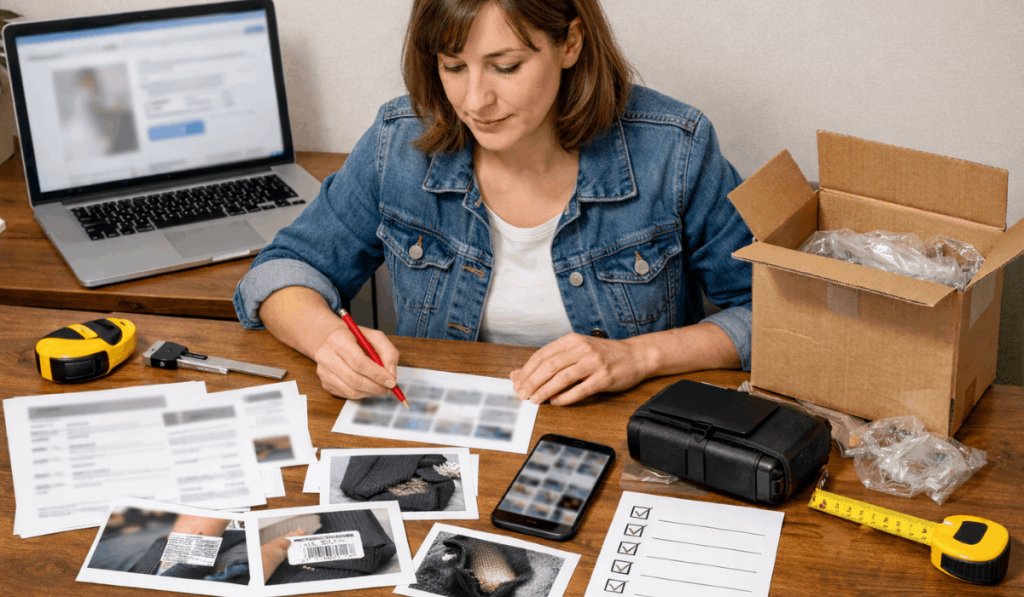
Collecting the right evidence before the first message saves time and prevents the seller from requesting the same information across multiple replies. Each piece should be ready to attach:
- Order ID, purchase date, and total paid: copy these directly from the order page so there is no confusion about which transaction is at issue
- Listing screenshots: capture the product page showing specs, color, size, and the exact variant selected at checkout
- Item condition photos: take wide shots and close-ups of damage or defects under good lighting, plus a photo of the shipping label
- Side-by-side comparison: place a screenshot of the listing next to a photo of what arrived, labeled “Photo 1” and “Photo 2” so the seller and the platform can verify the mismatch instantly
That labeled format matters. Sellers handling dozens of disputes a day can process a referenced photo faster than an attached image buried in a thread.
Decide the Outcome Before the First Message
This step gets skipped constantly. Buyers message the seller saying “this is wrong, what can you do?” and hand the seller control of the resolution. The seller then offers the cheapest option: a $2 coupon or a partial refund far below the item’s cost.
Deciding between a full refund, a replacement, or a partial refund before sending the first message lets the buyer set the terms. The seller responds to a specific request instead of offering whatever costs them least.
Message Templates That Work Across Language Barriers
Once the proof is gathered and the desired outcome is clear, the message itself should be short enough to translate cleanly. I would keep every initial message under 4 sentences on a platform like AliExpress, because longer messages get trimmed or garbled by auto-translation on the seller’s end.
Every template below follows the same structure: greeting, order ID, problem, proof reference, requested outcome, deadline.
Damaged Item Template
“Hi. Order #[ID]. Item arrived damaged. See Photo 1, Photo 2, Photo 3. I want a [replacement/refund] by [date].”
That is the entire message. No backstory. No emotional phrasing. The seller gets the facts, the proof location, and a deadline. Anything longer creates room for misinterpretation.
Wrong Item or Mismatch Template
“Hi. Order #[ID]. Ordered [size/color], received [size/color]. Photo 1 shows the label. I want [replacement/refund] by [date].”
The specific detail about what was ordered versus what arrived gives the seller no room to claim confusion. Including the label photo preempts the common reply of “are you sure you selected the right option?”
Shipping Delay Template
“Hi. Order #[ID]. Tracking has not updated since [date]. Screenshot 1 shows the last status. Please provide an update or resolution by [date].”
Shipping delays are trickier because customs and carrier handoffs can stall tracking for legitimate reasons. But if the buyer protection timer is running out, waiting for the seller to investigate is a losing strategy.
When to Stop Messaging and Open a Dispute
I think the widely repeated advice to “always try to work it out with the seller first” costs buyers money on platforms like AliExpress and Temu.
Sellers benefit from extended conversations because every reply cycle burns another 24 to 48 hours of the buyer’s dispute window. After 2 rounds of messaging with no clear resolution, opening a formal dispute protects the deadline.
That does not mean skipping the seller entirely. One clear message with proof and a deadline is fair. A second follow-up if the first goes unanswered is reasonable. But a third, fourth, and fifth round of “please wait, we are checking” is a stall pattern that runs the clock.
The dispute system on these platforms is designed to protect buyers, but only if the dispute is filed within the protection window. On AliExpress, that window is typically 15 days after delivery confirmation. Missing it by even a day can void the claim entirely.
Replacement vs. Partial Refund vs. Full Return
Picking the right resolution path depends on a few practical questions that go beyond “what do I want?”
| Resolution | Best When | Risk to Watch |
|---|---|---|
| Replacement | The item is wanted but arrived wrong or damaged, and the seller can reship with tracking | Adds another 2 to 4 weeks of waiting, and the replacement may have the same issue |
| Partial refund | The item is usable but flawed, like minor cosmetic damage or a missing accessory | Sellers often lowball the first offer, so counter with a specific dollar amount tied to the defect |
| Full refund with return | The item is unusable, unsafe, or completely wrong | International return shipping can cost more than the item, so confirm who pays before agreeing |
The return shipping cost is the detail that catches people off guard. Sending a $15 item back to China via tracked international mail can cost $25 or more. On low-cost items, a partial refund without return is often the smarter financial move.
Also read: How Currency Conversion Affects Final Price
Protect Future Purchases After a Dispute
Resolving one bad order teaches patterns that prevent the next one. The steps after resolution matter as much as the dispute itself because they build a system for smarter buying.
Save Everything From the Resolution
Screenshot the final resolution message, the refund confirmation, and any replacement tracking numbers. Platforms sometimes glitch or reset order histories. A saved screenshot is proof that exists outside the platform’s control.
Keep a simple note with the seller name, order ID, item link, and resolution date. The next time a seller’s name shows up during browsing, that note will flag whether they resolved issues honestly or stalled until the timer ran out.
Leave a Review That Helps Other Buyers
An accurate review matched to the final outcome gives other buyers real information. A 1-star review written during the anger of receiving a bad item, then updated to 3 stars after a smooth refund, tells a more complete story.
Rating the seller’s response speed and honesty matters more than rating the item itself. Other buyers can judge a product photo. They cannot judge how a seller handles problems without reading about someone else’s dispute.
Questions People Ask About Communicating With Overseas Sellers
Q: Can overseas sellers see my personal information when I message them?
Marketplace platforms like AliExpress and Temu only share the information needed for shipping. Sellers can see your shipping address and order details, but payment information stays hidden behind the platform. Avoid moving conversations off-platform, where those protections disappear.
Q: Should I message in the seller’s language or English?
English works fine because platforms auto-translate messages on both ends. Writing in short, simple sentences helps the translation tool produce cleaner output. Avoid slang and idioms like “this is a rip-off” that translate poorly.
Q: How long should I wait for a reply before escalating?
A 48-hour window is reasonable for the first reply, given time zone differences. After that, send one follow-up. If the second message gets no response within 48 hours, open a dispute directly through the platform while the buyer protection window is still active.
Q: Do sellers get penalized when buyers open disputes?
Disputes affect seller metrics on platforms like AliExpress, which is exactly why some sellers try to delay resolution through extended messaging. A dispute filed with clear evidence typically resolves faster than weeks of back-and-forth chat.
Q: Is it worth returning a cheap item to an overseas seller?
On items under $20 to $30, return shipping costs often exceed the item’s price. Requesting a partial refund without return is usually the more practical path. Check the platform’s policy first, because some categories qualify for refund-only claims without return.
Conclusion
Every overseas seller dispute comes down to three things: evidence quality, message clarity, and timing. Missing the dispute deadline turns a solvable problem into money lost for good.
The templates and proof checklist above can turn a frustrating cross-border purchase into a resolved case. Bookmark this page for the next time a package arrives and something feels off.