That pair of limited-edition sneakers ships from Tokyo. The price looks great. Then checkout adds three separate fees, and the “total” jumps by 8%.
Cross-border shopping in 2026 is fast. But the payment method for international shopping decides whether that speed costs you an extra $15 or $50 per order.
Every payment methods guide ranks credit cards first and stops there. The part that gets skipped is the refund math, the dispute timing, and the DCC trick that turns a deal into a loss.
This breakdown covers the best payment methods for international shopping, based on what happens after you click “pay” and something goes wrong.
Five Checks to Run Before Paying on an International Order
Clicking “place order” on a foreign marketplace takes about two seconds. Undoing a bad payment choice takes weeks. These five checks should happen at the checkout screen, not after the charge hits your account.
The order matters. Protection first, then cost, then security. A cheap payment method with zero dispute rights costs more in the long run than one with a small fee and a 120-day chargeback window.
Dispute Protection and Chargeback Windows
Chargeback windows vary wildly between payment methods. A credit card through Visa or Mastercard typically gives 120 days to file a dispute. PayPal gives 180 days but limits the types of claims.
Debit cards through most banks? Thirty days, maybe sixty, and the money already left your checking account.
I would pick a credit card with a 120-day chargeback window over PayPal’s 180-day window for international orders, because PayPal’s dispute resolution process has become slower and less predictable since late 2024. That timing gap matters less than the quality of the process behind it.

Currency Conversion Traps at Checkout
Two conversion options usually appear at checkout: pay in the seller’s currency or pay in your home currency. The second option is called dynamic currency conversion (DCC), and it almost always costs more.
DCC markups run between 2.5% and 4% above the mid-market rate.
A credit card’s own conversion spread is typically around 1%. So on a $200 order, DCC might cost $6 to $8 extra compared to letting your card issuer handle the conversion. Always select the seller’s local currency at checkout.
That one toggle saves more money per year than most cashback rewards programs return.
Credit Cards, Wallets, and Virtual Cards for International Shopping
Ranking payment methods by “safety” is what every article does, and the rankings all look the same. Credit cards on top, bank transfers on the bottom. The ranking itself is fine. The problem is that nobody explains the trade-offs between the top three options in a way that helps you pick one.
Credit Cards Are Still the Strongest Option for Disputes
A no-foreign-transaction-fee credit card is the default choice for international shopping. Zero FX fee, the card network’s exchange rate (close to mid-market), and full chargeback rights if the item never arrives or shows up damaged.
The catch: not every credit card drops foreign transaction fees. Cards that charge a 3% foreign transaction fee can wipe out any deal you found overseas.
Check this fee on your card issuer’s website before placing any international order. A card’s rewards rate means nothing if the FX fee eats the reward.
The Consumer Financial Protection Bureau has a comparison tool that breaks down credit card fee structures, including foreign transaction fees.
Digital Wallets: Good Privacy, Questionable Exchange Rates
PayPal, Apple Pay, and Google Pay all add a layer between the seller and your card number. That privacy layer is real and useful, especially when buying from a seller you have never used before.
But digital wallets set their own exchange rates. PayPal’s currency conversion fee runs around 3% to 4% above the mid-market rate. Apple Pay and Google Pay pass the conversion to your linked card, so the rate depends on the card, not the wallet.
The common advice is to default to PayPal for international purchases because of buyer protection. I disagree. PayPal’s conversion markup of 3-4% on a $300 order adds $9 to $12 in hidden costs that a no-FX-fee credit card avoids entirely.
The buyer protection sounds better on paper, but credit card chargebacks through Visa and Mastercard have stronger legal backing under the Fair Credit Billing Act.
If the wallet lets you select “pay in seller’s currency” and route the conversion through your linked card, it becomes a good option. If the wallet forces its own conversion, skip it.
Also read: How to Test Product Quality After Delivery
Virtual Cards and Disposable Numbers
Virtual cards generate a temporary card number tied to your real account. Services like Capital One and Citi offer these through their apps. The card number expires after one use or after a set time.
The advantage is specific: if a shady seller tries to rebill your card or a data breach leaks card numbers, the virtual number is already dead. Subscriptions, free trials, and unknown marketplaces are where virtual cards earn their keep.
Here is a comparison of the three main payment types for international orders:
| Feature | No-FX-Fee Credit Card | PayPal (Own Conversion) | Virtual Card |
|---|---|---|---|
| Foreign transaction fee | 0% | 3-4% markup | Depends on issuing card |
| Dispute window | 120 days (Visa/MC) | 180 days | Same as linked card |
| Seller sees your real number | Yes | No | No |
| Refund speed | 5-10 business days | 3-5 business days | 5-10 business days |
The takeaway: a no-FX-fee credit card paired with a virtual card number (when available) gives the lowest fees and the strongest dispute rights.
Fees That Quietly Add Up on International Orders
The listed price on an international marketplace is almost never the final price. Fees stack in layers, and each one is small enough to ignore individually but large enough to matter when combined across a year of purchases.
Foreign Transaction Fees and DCC Markups
These two fees are the biggest cost drivers, and they overlap in confusing ways.
A foreign transaction fee is charged by your card issuer. A DCC markup is charged by the merchant or payment processor at checkout.
Both exist to convert currency. Paying both at the same time is possible if the checkout uses DCC and your card also charges a foreign transaction fee.
Quick rules to cut these costs:
- Use a card with 0% foreign transaction fees (check your card’s terms, not marketing copy)
- Always select “pay in seller’s currency” at checkout to avoid DCC
- Avoid cards that code international digital purchases as cash advances, because cash advance fees are typically 5% or $10, whichever is higher
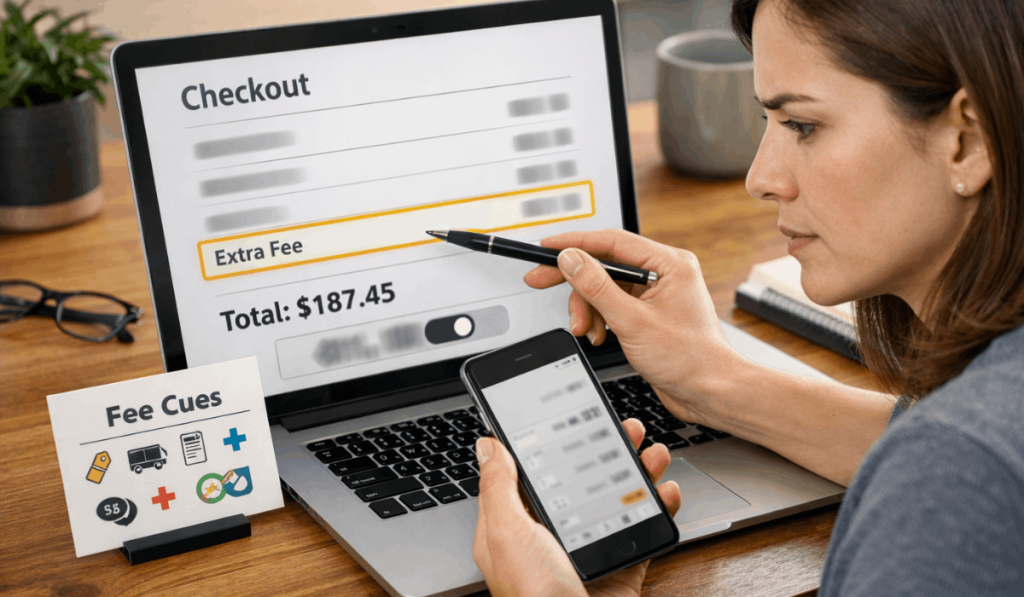
- Watch for a separate “service fee” or “processing fee” line at checkout, which some marketplaces add on top of everything else
Refund Conversion Loss: The Fee Nobody Tracks
A refund on an international order does not return the same dollar amount you paid. The exchange rate on the day of refund is different from the rate on the day of purchase.
On a $150 order with a 2% rate swing between purchase date and refund date, that is $3 gone. Multiply that across several returns per year, and the loss adds up quietly.
Keeping international purchases on a single dedicated card makes tracking these losses possible. Spreading purchases across four cards makes it invisible.
The Visa Exchange Rate Calculator lets you check rates on specific dates, which helps verify whether a refund amount matches what it should.
Matching the Payment Method to What Goes Wrong
Different problems call for different payment tools. A blanket “use a credit card for everything” approach works for simple situations, but the risk profile changes based on what and where you are buying.
High-Value Orders and Unknown Sellers
For orders above $200 from a seller with no track record, stack two protections: a credit card for dispute rights and a virtual card number for data protection. This combination limits financial exposure and keeps the real card number off the seller’s system.
Debit cards are tempting for budgeting purposes, but they pull money directly from a bank account.
A failed dispute on a debit card means waiting weeks for investigation while the money sits in limbo. That cash flow problem does not exist with credit cards, where the charge remains on the statement as a pending item.
Safety Settings to Lock Down Before Checkout
A few settings take less than five minutes and prevent the most common problems:
- Turn on two-factor authentication for every marketplace account and wallet
- Enable instant purchase alerts so a wrong charge gets flagged within minutes
- Set a spending cap on virtual cards tied to the expected order total
- Screenshot the final checkout page showing total price, delivery window, and return terms
- Keep the order ID, tracking number, and seller messages in one folder for dispute evidence
These steps seem basic, but skipping the screenshot alone has cost people entire dispute cases. Payment processors ask for proof. A screenshot taken at checkout is the strongest proof available.
Questions People Ask About Payment Methods for International Shopping
Q: Can I use a debit card for international online shopping?
Technically, yes. But debit cards pull funds directly from a bank account, and dispute protections are weaker than credit cards. Limit debit use to low-cost orders from trusted sellers.
Q: Does Apple Pay charge a foreign transaction fee?
Apple Pay itself does not add a fee. The foreign transaction fee (if any) comes from the card linked to Apple Pay. Check the linked card’s fee structure, not Apple’s.
Q: Should I always decline dynamic currency conversion?
Almost always. DCC markups run 2.5% to 4%, which is higher than what a card issuer charges for conversion. The only exception is if your card charges a foreign transaction fee higher than the DCC rate, which is rare.
Q: How long does a refund take on an international credit card purchase?
Refunds typically process in 5 to 10 business days after the seller issues them. The exchange rate at refund time may differ from the purchase rate, so the refunded amount can be slightly less than what was originally charged.
Q: Are virtual cards safe for international subscriptions?
Virtual cards are designed for this. Set the card to expire after one charge, and recurring subscriptions cannot rebill. Capital One and Citi both offer virtual card features through their apps.
Conclusion
Picking the right payment method for international shopping comes down to fees, dispute rights, and refund timing. A no-foreign-transaction-fee credit card covers the widest range of risks for cross-border orders.
Declining DCC at checkout and screenshotting the final total prevents the two most common billing surprises. Stack a virtual card on top when buying from an unfamiliar seller, and the safety gaps close almost entirely.