You can’t trust marketplace reviews just because the rating looks high.
You need proof, consistency, and reviewer credibility to separate real experiences from paid or fake feedback.
This guide shows you exactly how to spot reviews you can actually rely on before you buy.
Define What “Trustworthy” Means in Marketplace Reviews
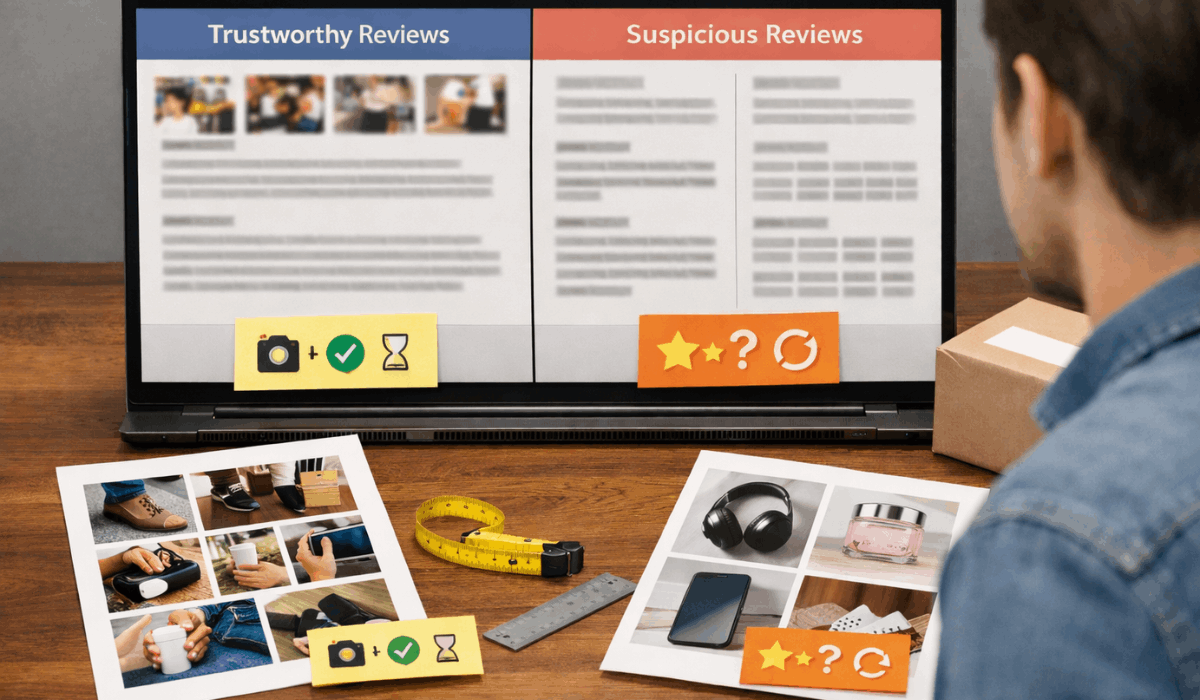
A trustworthy marketplace review shares exact product details and supports them with real photos, clear use context, and specific pros and cons.
It stays consistent with other credible reviews and matches the listing’s specs, seller behavior, and delivery reality.
What a Trustworthy Review Includes
A trustworthy review helps you confirm what you’ll actually receive and how it performs.
You should look for clear details and evidence that match the listing.
- Exact product variant details (model, size, color, version)
- Real photos or video that clearly match the item
- Use context (how it was used, how often, and for what purpose)
- Time-based feedback (first impressions vs after days/weeks)
- Specific pros and cons with examples, not generic praise
- Fit/compatibility notes (especially for tech, parts, clothing, accessories)
- Delivery and packaging notes (condition on arrival, missing parts, damage)
- Quality and durability observations (materials, build, wear, defects)
- Accuracy vs listing (what matched, what didn’t)
- Return/support experience if something went wrong
What “Untrustworthy” Reviews Usually Look Like
Untrustworthy reviews often feel vague, rushed, or overly perfect.
You should treat them as a warning sign, especially when they don’t prove anything about the real product.
- Generic praise with no specifics (no model, size, or version mentioned)
- Extreme ratings with no explanation (1-star or 5-star with one short line)
- Repeated phrases across many reviews that sound copied and pasted
- Too many reviews posted in a short time (sudden burst pattern)
- Photos that look like stock images or don’t match the listing
- Reviews that describe a different product than the current listing show
- Overly promotional tone that reads like an ad
- Mentions of incentives (free item, discount, “asked to review”)
- Reviewer profiles with suspicious history (only 5-star reviews, same style)
- Unnatural wording or odd formatting that feels automated
Start With the Reviewer, Not the Rating
Start with the reviewer because star ratings can be manipulated. A quick profile check often tells you if the feedback is real.
- Check purchase verification. Prioritize verified buys when available.
- Scan review history. Look for normal timing and mixed categories.
- Look for balanced ratings. Trust reviewers who explain 3–4-star ratings.
- Check writing consistency. Detailed, varied wording is a good sign.
- Watch for review farming. Many short, similar reviews are a red flag.
- Prefer evidence. Original photos or videos add credibility.
- Match claims to the listing. Confirm the exact variant lines up.

Read Reviews Like an Investigator
Reading reviews like an investigator helps you spot patterns that fake feedback can’t maintain.
You’re looking for consistent details, real evidence, and clear matches to the listing.
- Look for repeatable details. Trust reviews that mention the same specific strengths or problems across different buyers.
- Separate facts from feelings. Focus on what arrived, how it performed, and what changed over time.
- Check photo consistency. Real buyer photos usually vary, but still show the same product features.
- Verify the exact variant. Confirm the review matches your model, size, color, and bundle.
- Watch for sudden pattern shifts. A recent cluster of complaints can signal a quality drop or listing swap.
- Read mid-star reviews closely. 2–4-star reviews often explain real trade-offs and common issues.
- Compare “pros” to “cons.” Reliable reviews include both, with clear examples instead of vague praise.
- Flag mismatch clues fast. Mixed product photos, conflicting specs, or odd packaging claims are warning signs.
Use Filters the Right Way
Filters can help you find the most useful reviews fast, but the wrong filters can hide real problems.
You should use filters to surface evidence, recent changes, and honest tradeoffs.
- Sort by most recent first. This helps you catch quality drops, seller changes, or listing swaps.
- Filter for photos and videos. Evidence-based reviews are harder to fake and easier to verify.
- Read 2–4 star reviews on purpose. These often include the clearest pros, cons, and real-world issues.
- Use “verified purchase” when available. It reduces spam, but you still need to check the details.
- Filter by your exact variant. If the platform allows it, match size, color, and model to your choice.
- Check your region or shipping method. Delivery and authenticity risks can change by location and route.
- Avoid “top reviews” as your only view. Those can be boosted and may not reflect the current reality.
- Don’t rely on 5-star-only filtering. It removes the reviews that usually mention defects and returns.
Watch for Seller and Listing Signals That Confirm Reviews
Reviews make more sense when you compare them with the seller and the listing itself.
You should look for signals that support reviewers’ claims and expose hidden risks.
- Check seller history and consistency. A long track record with steady ratings is more reliable than a brand-new store.
- Confirm clear policies. Strong listings show returns, warranty terms, and customer support details.
- Scan the Q&A section. Helpful answers and consistent responses can confirm review claims.
- Look for complete specs and photos. Trust listings with measurements, materials, and clear images from multiple angles.
- Watch for vague or missing details. Missing specs, unclear variants, and generic photos weaken review value.
- Spot listing “over-optimization.” Keyword stuffing and exaggerated claims often match low-trust review patterns.
- Check for product/variant mismatch. If reviewers mention a different model or packaging, the listing may have changed.
- Compare complaint themes to the listing. Repeated issues such as “not as described” or “missing parts” should align with visible gaps in the listing.
Know the Most Common Review Scams
Knowing the most common review scams helps you avoid listings that look popular but aren’t reliable.
You should learn these patterns so you can spot them in seconds.
- Incentivized reviews (free item, discount, or reward for a positive rating)
- “Refund after review” schemes (seller offers money back if you leave 5 stars)
- Review farming accounts (profiles built to post many quick, generic reviews)
- Copy-paste review templates (same phrases repeated across different buyers)
- Bot-generated reviews (unnatural wording, odd pacing, and vague claims)
- Photo recycling (the same images used across multiple reviews or listings)
- Listing swaps / review hijacking (good reviews belong to an older, different product)
- Variant mixing (reviews for different models/colors merged into one feed)
- Brigading (sudden bursts of high ratings to bury recent complaints)
- Fake “verified” signals (bad actors exploiting loopholes in verification labels)
What to Do When Reviews Are Inconclusive
Sometimes reviews don’t give you a clear answer because the product is new, the listing changed, or the feedback is mixed.
In that case, you should switch to safer steps instead of guessing.
- Cross-check outside the marketplace (YouTube, forums, Reddit, brand/retailer reviews)
- Message the seller with specific questions (photos, measurements, compatibility, warranty)
- Choose a listing with strong return protection and clear dispute rules
- Buy from official stores or authorized resellers when the item is high-risk
- Start with a small test purchase before spending more
- Pick local shipping options to reduce delays and return problems
- Use a payment method with buyer protection (chargeback/dispute support)
- Wait for more recent reviews if the product is new or changing fast
- Compare alternatives with clearer proof and better review consistency
- Walk away if key details stay unclear (variant, authenticity, support, returns)
The Bottomline
You can trust marketplace reviews when you focus on evidence, consistent details, and credible reviewer behavior, not just high star ratings.
When reviews are unclear, you reduce risk by checking seller and listing signals, using smart filters, and cross-checking outside sources.
Use this checklist before your next purchase, and share this guide with a friend who shops on marketplaces so they can avoid bad buys too.