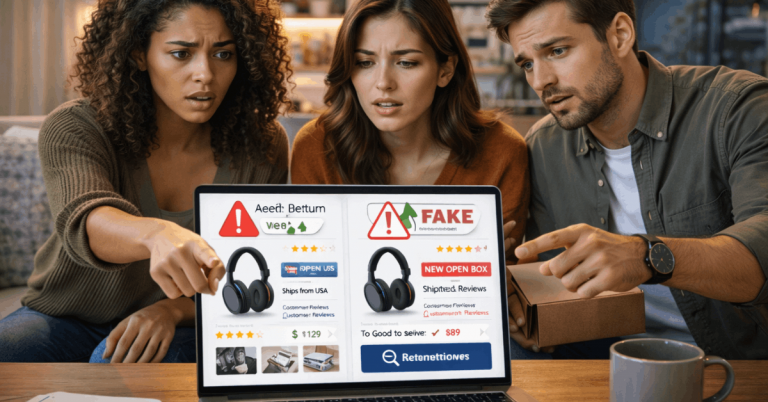
That AliExpress listing looks perfect. Five stars, 10,000 orders, a price that seems too good. So why does your gut still say “maybe not”?
Your instinct is picking up on marketplace trust signals that your brain hasn’t processed yet. Those small clues scattered across a listing page tell you whether a deal is real or a regret waiting to happen.
Learning to read these trust signals turns a 50/50 gamble into a calculated decision. Cross-border shopping gets easier once the guesswork drops out.
This is the checklist I wish someone had handed me before my first international marketplace order. Every signal mapped to the exact risk it protects against.
Marketplace Trust Signals Start on the Listing Page
Product quality problems almost always begin before checkout. The listing page is where sellers either prove their product or hide behind stock photos and vague descriptions. And the difference between those two scenarios? About 30 seconds of checking.
A few signals on the listing page separate a confident buy from a risky click.
Close-Up Photos of Weak Points Tell More Than Hero Shots
Sellers who photograph edges, seams, hinges, connectors, and undersides are showing you the parts that break first. A product shot from a flattering angle tells you nothing about build quality.

Look for consistent visuals across all images. The same finish, same color tone, same texture. If the product looks slightly different in every photo, the seller may be mixing stock images from different factories.
Measurable Specs Beat Vague Marketing Language
A listing that says “premium quality alloy” is hiding something. A listing that says “6061-T6 aluminum, 2.3mm thickness, 142g” is giving you something you can verify.
Exact dimensions, weight, and material grades matter more than adjective-heavy descriptions. If a seller can’t tell you the thickness of their phone case or the wattage of their charger, treat that gap as a warning.

The same applies to compatibility details. A listing should specify the exact plug type, voltage range, and connector standard. “Universal compatibility” without specifics is marketing, not information.
Variant Confusion Causes More Disputes Than Defects
I think variant confusion on platforms like AliExpress and Temu causes more buyer disputes than defective products, based on how often 1-star reviews mention receiving the wrong size or color rather than a broken item.
Clean variant selectors with distinct SKU-like identifiers reduce that risk. If the listing uses identical photos for three different sizes, or the color names don’t match what’s shown, the ordering process itself becomes a gamble.
Check your included items list too. Cables, adapters, manuals, and spare parts should be spelled out. “Full package” means nothing. A complete list means the seller has actually inventoried what ships in the box.
Seller Trust Signals That Predict Post-Purchase Behavior
Listing quality tells you about the product. Seller signals tell you what happens after the payment clears. This distinction matters because a decent product paired with a terrible seller still equals a bad experience.
Checking seller reliability takes less than two minutes, and it’s the step that protects your refund rights if something goes wrong.
Store History and Category Consistency
A store that has been active for 3+ years and consistently sells electronics is a different bet than a 6-month-old store that jumps between clothing, gadgets, and home decor. Category consistency tells you whether the seller understands their own products.
Stable store history with regular listings, steady review accumulation, and no long gaps signals a seller who plans to stick around. New sellers aren’t automatically bad, but the risk profile is higher, especially on high-ticket items.
One Pre-Buy Message Reveals Everything
Send the seller one short, specific question before checkout. Something like: “Does this model include the USB-C cable shown in photo 3?”
Response speed and quality predict future behavior better than any star rating. A seller who replies within hours with a direct answer will probably handle a post-delivery problem the same way.
A seller who ignores the question or replies with a generic copy-paste? That tells you exactly how a refund request will go.
Return Policy Details Worth Reading
The refund window, conditions for returns, and who pays return shipping: these three details protect you more than any badge or verification label. If the listing or store page doesn’t spell these out, assume the worst and plan accordingly.
Marketplace-level buyer protection and seller-level return policies can differ. Check both. A platform might offer a 15-day dispute window while the seller advertises 30-day returns. The shorter window is the one that matters.
| Trust Signal | What It Predicts | How to Check |
|---|---|---|
| Close-up photos of weak points | Product build quality | Look for seam, hinge, and edge shots |
| Measurable specs (dimensions, weight) | Listing accuracy | Compare numbers to similar products |
| Seller message response time | Post-purchase support quality | Send one direct question before buying |
| Return policy specifics | Refund likelihood if problems arise | Read platform AND seller policy separately |
| Photo reviews matching your variant | Real-world product appearance | Filter reviews by your exact size/color |
The fastest way to use this table: check the seller response time first, because that single signal predicts almost everything else about the buying experience.
Also read: When Not to Buy From International Marketplaces
Review Signals Worth Trusting on Cross-Border Marketplaces
Star ratings are noise. A 4.7-star average across 5,000 reviews tells you almost nothing useful about whether the medium blue hoodie in size L will fit the way you expect.
The reviews that matter are specific, visual, and time-stamped. Everything else is background static.
Photo Reviews That Match Your Exact Variant
A photo review of the black version doesn’t help when you’re ordering white. Filter for your exact variant: size, color, model, and region version. These filtered reviews are your real product preview.
Close-up buyer photos showing wear after a few weeks of use beat day-one unboxing shots. A product that looks great on day one but peels or loosens by week three has a quality problem that only time-based reviews reveal.
Repeat Complaint Patterns Are More Reliable Than Star Averages
I would trust a 4.2-star product where 3 out of 50 photo reviews show the same seam issue over a 4.8-star product where no photo reviews exist at all.
Repeat patterns across multiple buyers confirm a real issue. One complaint about a dent could be a shipping fluke. Five complaints about dents mean the packaging is weak. Look for the same defect, delay, or mismatch mentioned independently by different buyers.
Reviews that include context matching your situation are gold. A reviewer in your country mentioning customs delays or local carrier handoff problems gives you better delivery predictions than the seller’s estimated timeline.
Shipping and Price Signals That Flag Hidden Risk
Shipping and pricing each carry their own trust signals that most buyers scroll past. These signals predict delays, surprise fees, and damage risk before you confirm the order.
Shipping Method Transparency and Tracking Quality
A clear shipping method name tied to a realistic delivery window for your country is a green flag. “Standard shipping, 15-25 business days” is acceptable. “Fast delivery” with no carrier name and no tracking? That’s a red flag.
Tracking that updates regularly through each transit milestone matters more than the estimated arrival date. Long gaps with no tracking movement suggest the package is sitting in a warehouse or consolidation center.
Carrier handoff clarity is the signal nobody talks about. The moment a parcel transfers from the international carrier to your local delivery service is where packages get lost or delayed. Listings or sellers that specify this handoff process have better logistics.
Customs and fees transparency protects against a different kind of surprise. A package stuck at customs because the seller under-declared the value creates delays and sometimes extra charges. Check if the seller mentions customs handling or declared value practices.
Price Signals That Suggest Higher Risk
A price far below the category average for similar specs deserves scrutiny, not celebration. The discount needs an explanation: overstock, older model, direct factory pricing. If no explanation exists, the quality difference is probably the explanation.
Watch for these pricing red flags:
- Heavy urgency tactics like countdown timers, “last 3 units” warnings, and stacked coupon displays that create pressure rather than savings
- Shipping price manipulation where the item price is suspiciously low but shipping is $15-20 higher than comparable listings
- Unexplained variant price jumps where the large size costs 3x the small size without any material or spec difference listed
- Bundle deals that seem unrealistic with five “free” accessories adding perceived value that doesn’t hold up under scrutiny
High-ticket items from sellers with fewer than 50 total orders and little review history carry the highest risk profile on any cross-border marketplace.
The 60-Second Trust Scorecard for Any Marketplace Listing
Speed matters. Spending 20 minutes analyzing every listing defeats the purpose of bargain shopping. This scorecard works in under a minute and covers the signals that predict 90% of bad outcomes.
Run through these checks before confirming payment:
- Variant match confirmed: your exact size, color, model, and region version selected in both the listing and checkout
- Close-up photos exist: weak points like edges, seams, and connectors are shown, not just hero angles
- Specs are measurable: dimensions, weight, thickness, or capacity listed with actual numbers
- Seller responded to a test question: fast and specific reply received
- Photo reviews match your variant: real buyer images showing the version you’re ordering
- Shipping is tracked and realistic: named carrier, believable timeline, and regular tracking updates
- Return policy is specific: window length, conditions, and return shipping costs all stated clearly
Two or more fails on this scorecard? Either downgrade your expectations, reduce exposure by ordering one unit at a lower price point, or walk away entirely.
What to Do Immediately After Delivery
Post-delivery documentation protects your dispute rights. These steps take five minutes and can save the full purchase price if something goes wrong.
Record the sealed package and shipping label from all sides before opening. Film the unboxing in one continuous take, showing packaging quality, inserts, and the product itself.
Photograph the item from multiple angles and take close-ups of any areas that commonly show defects. Measure the specs the listing promised: size, weight, and thickness, with the measuring tool visible in the frame.
Save screenshots of the original listing, including photos, specs, and the variant selected. If an issue exists, message the seller within 24 hours with a short summary and attach the evidence. The AliExpress Buyer Protection Center outlines specific timelines for filing disputes, so checking those windows early prevents missed deadlines.
Cross-border consumer protection rules vary by country. The European Consumer Centre has detailed guidance for EU-based buyers dealing with sellers outside Europe.
Questions People Ask About Marketplace Trust Signals
Q: Are verified purchase badges on marketplace reviews trustworthy?
Verified purchase badges confirm a transaction happened, but they don’t confirm the review is honest. Incentivized reviews from “free product” programs carry verified badges too. Photo reviews with specific detail remain the strongest signal regardless of badge status.
Q: How do I spot fake reviews on AliExpress or Temu?
Look for reviews posted within a 48-hour window using similar phrasing. Fake review batches tend to cluster in time and use generic praise without mentioning specific product details. Reviews that include measurements, fit notes, or photos of packaging are harder to fake.
Q: Should I always message a seller before buying on an international marketplace?
One message can save a lot of frustration. Send a short, specific question about the product. The response speed and accuracy predict how the seller handles post-purchase problems. A seller who doesn’t reply before the sale probably won’t reply after it either.
Q: Does a high order count on a listing mean the product is good?
High order counts mean the price attracted buyers. They don’t confirm quality. A listing with 20,000 orders and a 4.3-star rating may have thousands of disappointed buyers mixed in. Filter by 1-star and 2-star reviews with photos to see what the order count hides.
Q: Is marketplace buyer protection enough to skip checking trust signals?
Buyer protection programs have time limits, evidence requirements, and dispute resolution processes that favor documented claims. A buyer who photographs everything and messages within 24 hours wins disputes at a far higher rate than someone filing a complaint weeks later with no proof.
Conclusion
Marketplace trust signals turn cross-border shopping from a coin flip into a repeatable, low-risk process. The 60-second scorecard catches the problems that star ratings and order counts hide completely.
Every signal maps to a specific risk, so checking them takes minutes, not hours of overthinking. Start with the seller response test on your next order and build the habit from there.